If staying organized has always felt harder for you than it seems to be for other people, you’re not lazy — and you’re certainly not alone.
Many older adults are only now beginning to recognize signs of ADHD later in life. Others may have spent years simply believing they were “messy,” “disorganized,” or “bad at keeping up with things.”
But often, there’s much more to the story.
For seniors and empty nesters, years of busy life, raising families, caregiving, careers, and simply accumulating belongings can make organizing feel overwhelming — especially when ADHD is part of the picture.
And here’s something important to know:
The problem isn’t necessarily you. Sometimes the problem is that the organizing systems you’ve tried were never designed for the way your brain naturally works.
The good news? Small changes and simpler systems can make everyday life feel much calmer and more manageable.
ADHD Often Looks Different in Older Adults
Many adults in their 50s, 60s, and beyond were never diagnosed with ADHD as children because people simply didn’t know as much about it as they do today.
Instead, they may have spent years:
- Losing track of papers or keys
- Feeling overwhelmed by clutter
- Starting projects but struggling to finish them
- Avoiding certain rooms or piles altogether
- Feeling mentally exhausted by decision-making
And over time, those small struggles can quietly build into homes that feel stressful or difficult to manage.
That’s why organizing for ADHD is not about trying harder.
It’s about making your home easier to function in.
The Secret to Organizing With ADHD: Reduce Friction
The #1 rule of organizing for ADHD is this: the fewer steps it takes to put something away, the more likely it is to actually get put away.
Every extra step between “I’m done with this” and “it’s back where it belongs” is a friction point — a tiny moment where the system breaks down. And for an ADHD brain, even one unnecessary step is enough to derail the whole thing.
This is why traditional organizing advice (“everything has a place!”) often falls short. If the place requires opening a drawer, finding the right bin, removing a lid, and closing everything back up — that’s four steps too many.
ADHD-friendly systems minimize steps. They use visual cues rather than memory. And they make the easy thing and the right thing the same thing.
Good systems work with your habits — not against them.
Let’s look at how to organize a home for someone with ADHD by looking at how that plays out room by room.
Entryway Organizing: Make Coming Home Easier
The entryway quietly affects your entire day.
When the area near the front door becomes crowded with shoes, bags, jackets, or packages, leaving the house can start to feel stressful before the day even begins.
A few simple changes can help:
- Add hooks for jackets or purses
- Place a basket near the door for shoes
- Use a tray for keys, glasses, and mail
- Keep walkways as open as possible
In many Morgan Hill homes, entryways become “temporary drop zones” that slowly turn permanent. Resetting this space often creates an immediate sense of relief.
Kitchen Organizing
Kitchen organizing is tricky for anyone, but especially for ADHD-friendly organizing because there are so many categories and moving parts. Not only do you need all the categories for food prep and appliances, but it tends to be a drop zone for papers, mail, or a broken doodad that you’ve been meaning to superglue.
Cooking itself requires a lot of executive function between all the ingredients, equipment, and timing. When it’s time to clean up afterward, the brain is already worn out, so let’s make it as easy as possible to tidy up in the kitchen.
Here are a few common practices to help you stay organized:
- Clear Containers*: When you can see what you have at a glance, you actually use it. Solid color containers create an “out of sight, out of mind” problem that leads to forgotten food, duplicate purchases, and dinner-time decision paralysis.
- Counter Tray: Some things are going to live on the counter, no matter what. Instead of fighting it, designate a specific zone and contain it. A small tray or vertical file holder keeps papers from spreading and gives you a place to drop mail every day. Label it “To Sort” and keep papers contained without requiring immediate decisions. Trays also work well near the sink for soaps or scrub brushes.
- Simplify Cabinets: It should be extremely easy to put away common items like dishes, pots and pans, and silverware. If it requires more than one or two steps, it’s time to simplify or things won’t get put away.
* Don’t purchase containers before you know what you need! Assess what you need to store, and then purchase new items if needed.
Living Room Organizing
The living room is the room where everything from every other room eventually ends up. Blankets, chargers, reading glasses, snacks, that one shoe — it all drifts here, because this is where you actually live.
For ADHD brains, the living room needs to be designed for the way it’s actually used, not the way it’s supposed to be used:
- Baskets and Trays. Sensing a theme? A large basket by the couch isn’t clutter when it’s used intentionally. Drop blankets, books, and anything else into it if they legitimately live in the space. A tray on the coffee table corrals remotes, chapstick, and the other small things that always end up there anyway.
- Create a Reset Bin. Keep one attractive bin or basket in the living room, designated for items that need to go elsewhere in the house. Instead of making multiple trips, everything gets dropped in the bin and sorted once — either at the end of the day or whenever it feels manageable.
- Charging Stations. Cords and devices pile up because people charge things where they use them. Rather than fighting it, create a small, designated charging zone right in the living room. A little tray or station makes it intentional — and suddenly the cords have a home.
Bedroom Organizing
The bedroom is where the day ends and where the next one begins — which makes it prime territory for ADHD struggles. Clothes end up on the floor (or the “chair”— you know the one), things can’t be found in the morning, and the space never quite feels restful.
A few systems that help:
- Worn Once Area. Every bedroom has a chair that collects worn-but-not-dirty clothes — because they don’t belong in the hamper but also don’t need to be hung back up. Instead of fighting this, set a designated spot (hooks, a small rack, or an open basket) for “worn once” clothes. This removes the guilt and gives those items an actual home.
- A Functional Nightstand. The nightstand should only hold what’s needed at night and in the morning. Your phone charger, water, and anything else you need before bed. Clutter on the nightstand = clutter in the brain before sleep.
- Tomorrow’s Outfit. For seniors with ADHD, choosing clothes the night before removes an entire decision-making task from the morning. A small hook or designated spot at the end of the bed or on the back of the door makes it easier to build this habit.
- Hamper Placement. A hamper that requires walking to the closet will go unused. Put it where clothes actually get taken off — right next to where people get undressed — and suddenly laundry starts making it in.
Bathroom Organizing
Bathrooms are small, but for someone with ADHD, a cluttered bathroom counter can derail the entire morning. When it takes too long to find things, or the routine has too many steps, it doesn’t get done — or it gets done halfway.
Clear containers or drawer organizers can help keep “like” items together (think: hair products, skincare, & daily essentials). But the key is to avoid overfilling them.
If everything barely fits, it won’t stay organized.
Here are a few other tweaks that make a real difference:
- Daily Items in Open View. This might feel messy, but for ADHD brains, out of sight genuinely means out of mind — and out of the routine. A small tray to corral the daily essentials keeps it looking intentional without adding steps.
- Drawer Dividers. Drawers are fine for backup supplies, but they should be simple and clearly divided. Tossing everything loose into a drawer creates the “dig and give up” problem every single time.
- Hooks for Towels. This is the bathroom version of hooks over hangers. Hanging a towel on a hook takes one motion. Folding and draping it over a towel bar takes five. Hooks always win.
The DOOM Pile Room
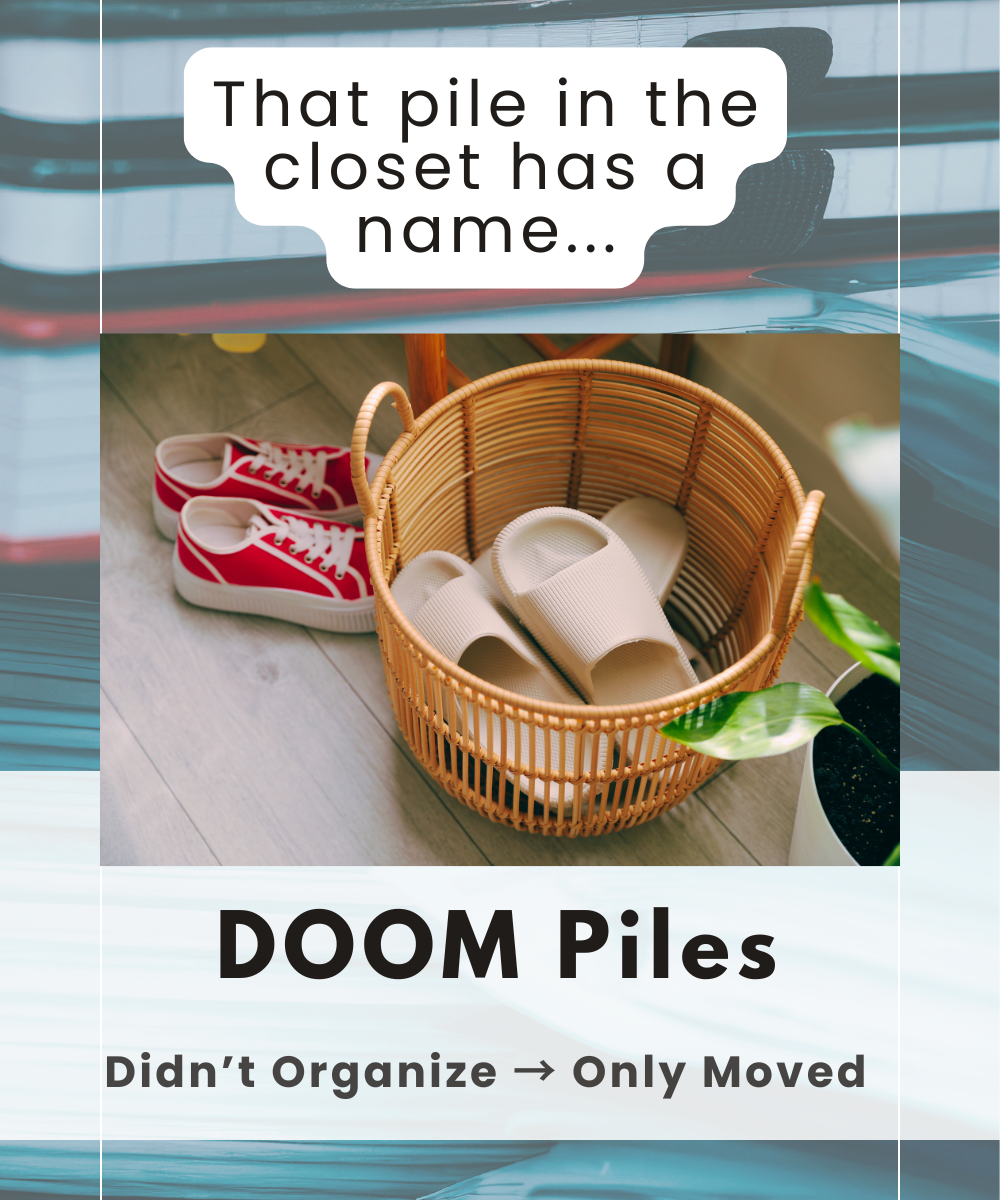
DOOM = Didn’t Organize, Only Moved.
These are the piles that accumulate over time to “deal with later” and they tend to collect in spaces that are out of sight and not used often. You know the ones…guest rooms, home offices, closets, or the basement corner that quietly collects a very random pile of piles.
DOOM piles usually grow because those are items that don’t have a home. Then they collect in a room or space that becomes the default holding zone for everything without a clear destination.
The key to tackling these piles isn’t a marathon organizing session (which is exhausting and hard to sustain for ADHD brains). It’s building better systems in the rooms where things should live first, so items have somewhere to actually go.
Once the rest of the house has real homes for things, the pile stops growing — and clearing it out becomes much more manageable.
The Bigger Picture: Systems Over Willpower
Here’s the most important thing to know about organizing a home for someone with ADHD — it’s not about trying harder. It’s about designing smarter.
When simple systems are in place — a hook for keys, open storage, visual cues, minimal steps, and a layout that works with how the brain naturally operates — staying organized stops feeling like a constant uphill battle.Setting up those systems is exactly what we do as professional organizers. We don’t just tidy up, we design systems that actually work for the specific person using them. An ADHD-friendly home doesn’t look a certain way; it functions in ways that make daily life easier.
Ready to Make Your Home Feel Easier to Manage?
If clutter feels overwhelming, you don’t have to figure it out alone.
At Poppy Jasper Organizing, I help seniors and empty nesters in Morgan Hill and surrounding areas create homes that feel calmer, more functional, and easier to live in — especially for people who have struggled with organization for years.
Together, we create simple, realistic systems that work for your habits, energy, and daily life.
Because organizing shouldn’t feel like a constant uphill battle — and it’s never too late to make your home feel lighter.
You got this!
Tami
~Helping you let go without losing what matters~